COMBINED LAND AND SEA IPA IN SIGHT FOR SE ARNHEM LAND
After much hard work, Traditional Owners of South East Arnhem Land are finally within sight of adding a huge swathe of Sea Country along the western edge of Gulf of Carpentaria to their existing land-based Indigenous Protected Area.
For the coastal clan groups in particular, the IPA’s dedication due in late 2025 will be the fulfilment of a long-held dream. Knowledge of underwater sites – many of them in areas that used to be dry land – has persisted for hundreds of generations, and for this reason Traditional Owners seldom differentiate between marine and land domains.
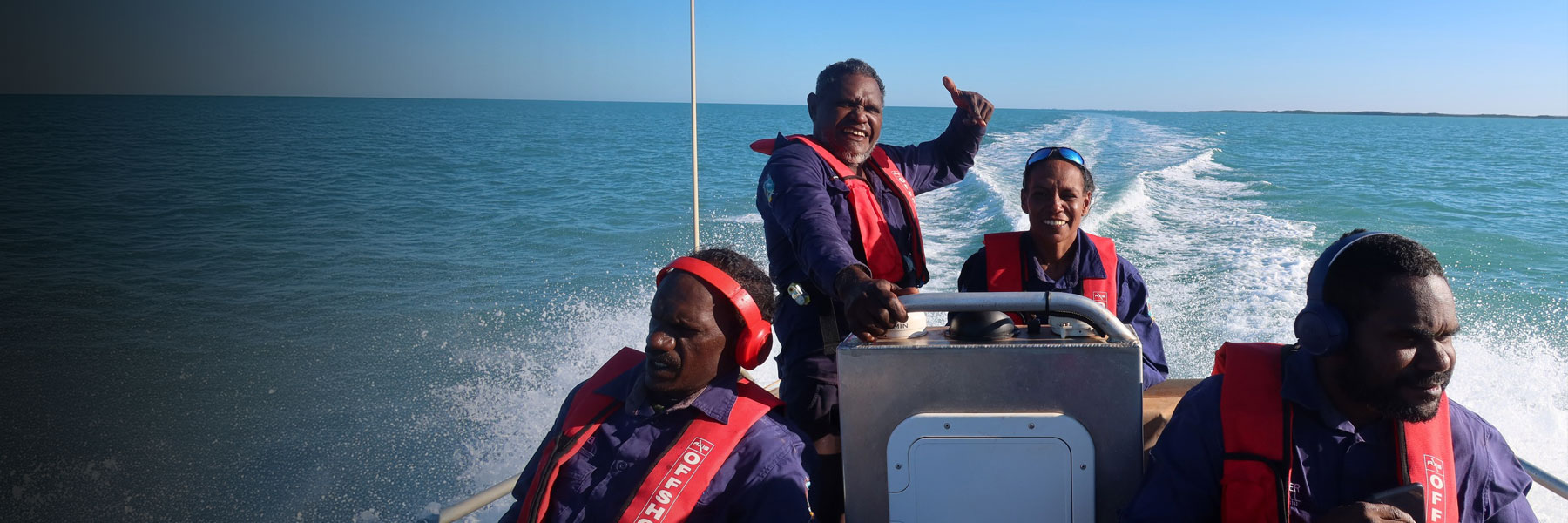
Clive Nunggarrgalu is a Senior Ranger for Numburindi Rangers, representing one of the two main coastal groups.
“[This Sea Country IPA] is very important for us,” Clive said. "Everything here today we got a songline for, and they all connect, even on the mainland and the sea. It's all part of the same Country.
“It's a really, really long time we've been waiting for this IPA. Because I'm a saltwater man I love living on the sea, looking after everything on the seaside, so I'm very excited to get that Sea IPA.”
WATCH
Discover SE Arnhem Land IPA
Protecting culture and ecology
The Sea Country boundaries will wrap around the existing Anindilyakwa Sea Country IPA (centred on Groote Eylandt) and extend 300km along the coastline and 140km out into the Gulf, covering an 8,610sq km area of great cultural and ecological importance including reefs, shoals, estuaries, extensive mangrove forests and some of the largest swathes of seagrass meadow remaining in Australia.
The Gulf’s warm waters are home to a rich array of sea and bird life, including marine turtles, dugongs, dolphins, sea snakes, saltwater crocodiles, sawfish and colonial-breeding seabirds such as egrets, terns, ospreys and cormorants. However, the Sea Country – called ‘larkaya’ by local clan groups – is under pressure from marine rubbish such as ghost nets, pollution, fishing and the impact of climate change which has been implicated in recent alarming and widespread mangrove diebacks.
"When we get this Sea IPA we're going to protect the seaside, picking up all of the rubbish along the coast, checking all the crab pots and the fisheries and seeing if people fishing have permission,” Clive said. “They’ve got to have a permit for fishing in many areas.”
Momentum for a Sea Country IPA began building in 2020 with the awarding of federal funding to develop a formal application. With support from our team at Country Needs People and the NT's Northern Land Council, consultations have since been under way with Traditional Owners and other affected groups, along with mapping, technical and ecological assessments.
CNP assisted with a final round of Sea Country cultural mapping during 2024, including organising two meetings with key traditional knowledge holders. This work has fed into a combined Plan of Management for the land and sea IPAs, which is now ready to be lodged with the Commonwealth to secure the Sea Country’s formal dedication.
Governance of the combined land and sea IPAs will continue to occur through the existing SEAL IPA Advisory Committee.
Intact ecosystems
The original south-east Arnhem Land terrestrial IPA was dedicated in September 2015 and incorporates 18,194sq km of freehold Aboriginal land stretching from Blue Mud Bay in the north to the Roper River in the south. It covers Country and ecosystems that are mostly intact, as south-east Arnhem Land was largely spared the incursions of colonial settlers.
Traditional management practices remained strong, however invasive species and changed fire patterns have raised challenges. More than 1,000 native species are found across the region, including 200 species of native plants that are still used for traditional purposes.
The late Mr W.Thompson Senior, former Cultural Advisor for the SEAL IPA said,
“For a while there our Country was lost. Now we’ve got opportunity to work to look after Country, with two groups of Rangers looking after the [IPA].

Ranger operations
The two Indigenous Ranger groups managing the land IPA are the Yugul Mangi Land and Sea Rangers, based at Ngukurr on the Roper River, and the Numburindi Amalahgayag Inyung Rangers (the Numburindi Rangers) based at Numbulwar to the north on the coast. The groups work closely together and the IPA has grown to be a very successful community enterprise over the past decade.
The Rangers prioritise managing pest species, protecting native habitat, safeguarding sacred sites and delivering on-Country education to their communities' children. Rangers also put great effort into using planned cool burns to reduce wildfire risk on Country and now derive substantial income from the resultant carbon credits.
“The best way to talk about fire is that we use fire to make sure the Country is clean [for] our plants and our animals,” said Mr W.Thompson Senior.
“I guess we need to... educate some people that right-time burning is the right-way burning, and if you burn after August/September you get a hot burn which isn't good for nature.”
Two-way learning
“We learn from Ngukurr mob and Ngukurr mob learn from us. We share the job. We got eyes and ears to look after the Country", says Clive.
Mr W.Thompson Senior was proud of the important survey work Rangers were undertaking on native species in both land and sea, including a seagrass survey that was a joint operation between the Yugul Mangi and Numburundi Rangers.
“Our animals and our plants are the number one thing that we're supposed to be measuring or documenting, doing research on things that we think [have] been tampered with through climate change,” he said.
“The seagrass survey is going to be one of the indicators of temperature, the temperature of the water and of the land as well. If something's wrong with the land we won't survive, so that's how we got to make sure that we're doing survey.”
Banner Image: SEAL Rangers Steven Ngalmi, Clive Nunggargalu, Joanne Pomery and Preston Wurramara on Sea Country. Inset image: SEAL Rangers Steven Ngalmi, Preston Wurramara and Clive Nunggargalu clean up ghost nets. Photos: Northern Land Council.