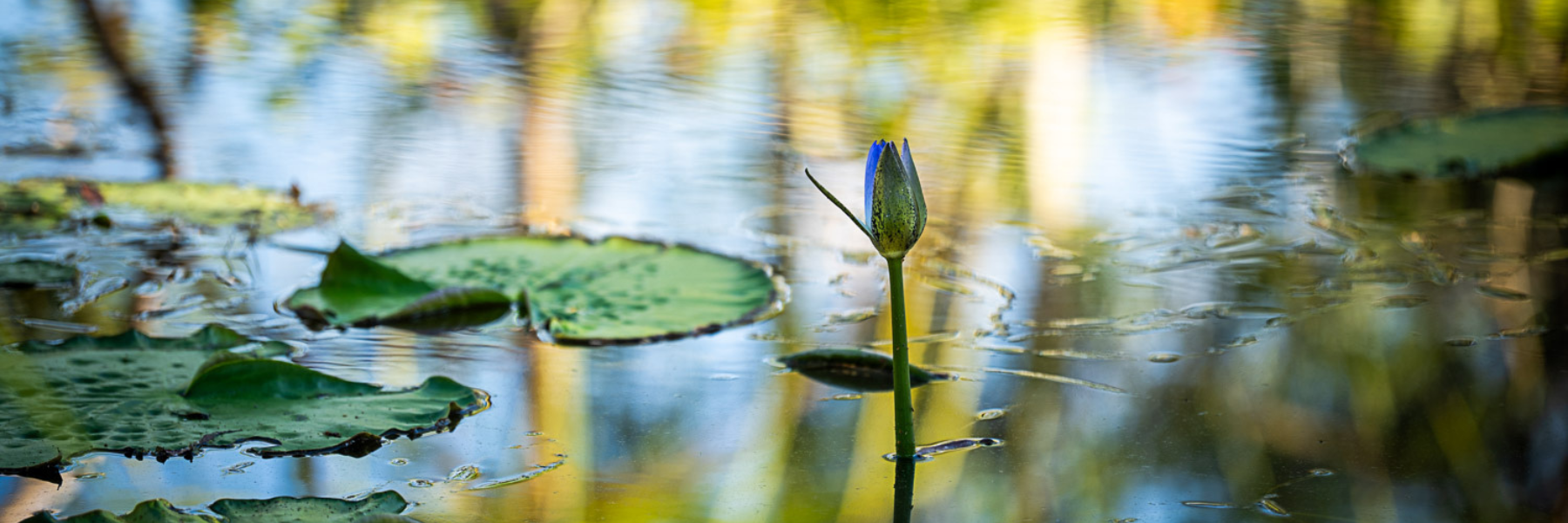
Gurruwiling is the heart of the 1.5M ha Arafura Swamp IPA in Central Arnhem Land, made famous in the film Ten Canoes, but is under attack by feral buffalo.
There’s two ways to get to Gurruwiling (Arafura Swamp) – a 1 hour 45 minute flight from Darwin via Tiwi Airlines to the closest town, or a 14 hour, 450km road trip, primarily on dirt. Flying into the main town - Ramingining - you fly low over a plethora of landscapes – from the inland stone Country to the jungles, rivers, wetlands and coast. From the plane it feels vast, remote, pristine, but it’s always a multiplicity of experiences when you get on Country and see the challenges firsthand.
Husband-wife team Gabriel Guyila and Marcia Malibirr live in Ramingining and both work for Arafura Swamp Rangers Aboriginal Corporation (ASRAC). “Beautiful Country in Ramingining”, says Gabriel, who has been employed as a ranger with ASRAC for 10 years. “My grandfather Peter was the first crocodile man, collecting eggs, getting live crocodiles. He told me to work here and learn from him. A long time ago when I was in school.”

“I speak my grandmother language”, explains Marcia. “I’ve been a ranger for three, four years.”
When I ask her what she’s learnt as a ranger, she describes the Yolŋu way of learning – “I just sit, and watch them, and then I learn from them. And here I am.”
Gurruwiling – a biocultural wonderland
Gurruwiling is the heart of this landscape - a nationally significant wetland that supports over 300,000 waterbirds, comprising 22 species. It’s stunning swamp Country where magpie geese build secret nests, iconic jabiru arch into the sky and crocodiles weave alongside acres of waterlilies. Known as Northern Australia’s largest wooded perennial freshwater swamp, it sits within a 700km2 basin.

1510 plant species have been recorded here, including rare vegetation such as the permanently flooded Hanguana malayana forest and almost the entire NT population of the giant wetland palm. Surrounded by 3,000 ha of monsoon rainforest Gurruwiling provides habitat for a distinctive Arafuran community that includes 707 types of vertebrate animals, including 30 threatened at either national or Territory levels. Threatened animals include the curlew sandpiper, great knot, eastern curlew and Pacific ridley, Gouldian finch and brush-tailed rabbit-rat.

This is all now Country managed for protection by Traditional Owners as part of the National Reserve system, under the 1.5M ha Arafura Swamp Indigenous Protected Area (IPA), which was made official in 2025. Strong Commonwealth Land Rights underpin management of land and sea Country. The region sits within the Arnhem Land Aboriginal Land Trust, land held as inalienable freehold, a tenure provided to Traditional Owners under Commonwealth legislation – the Aboriginal Land Rights (NT) Act 1976 - some of the strongest and most secure tenure in Australia.
“Gurruwiling is Arafura Swamp area. It’s very important that it’s protected. It’s very big and vast” says Gabriel.

Gurruwiling is not just a place of incredible biodiversity, it also carries huge cultural values for Traditional Owners. Gabriel and Marcia have a young family and both attest to how vital it is to go out on Country with them, and the essential intergenerational learning which takes place. “When we go to Country I teach my kids ‘don’t be silly, don’t play muck around, just listen to me what I’m saying’. I always do that”, says Marcia. “They listen to me and they talk to me. They’re excited for everything”.

“Very important for all the kids to have learning (here)” says Gabriel. “Teach them how to collect file snakes, turtle, fishing.”
Hunting and fishing are still an integral part of daily life, and it’s said you’re not going to like it here if you don’t practise those past times. Important traditional foods of Gurruwiling include lilies, water chestnuts, barramundi, long-necked turtles and magpie geese.
Ranger Team - one of the first
Ramingining is home to over 800 people. With just one store, one art gallery, a health centre, shire council and tiny library, ranger work is an important employer here, with 60 local people currently employed as Rangers through Arafura Swamp Rangers Aboriginal Corporation.

The Indigenous Ranger program here is one of the oldest in Australia and was initiated by Bi and Yolŋu Traditional Owners in Arnhem Land over 40 years ago. The ASRAC Rangers are coordinated through a hub in Ramingining. Three of the ranger groups operate from satellite bases on remote homelands—Donydji, Mirrngatja and Malyanargnak—and infrastructure is planned for more satellite ranger bases to support Traditional Owners and their families to live and work on their homelands.
“Gurruwiling, it’s our land, and we come from here, Arafura Swamp” says ASRAC Ranger Jason Malibirr, who takes us out by boat across the swamp.
“I love this Country. It’s a good job to protect our Country.”

On any given day the Rangers are doing multiple and varied tasks – from protecting biodiversity through monitoring threatened species, managing fire, fighting invasive weeds, and collaborating on scientific research projects with institutions and universities. ASRAC also have a crocodile farm business enterprise which keeps them busy harvesting eggs, incubating crocodiles, and selling them to the Darwin market, which helps supplement their ranger activities.

With an IPA which provides key habitat and feeding grounds for a huge population of migratory birds and waterbirds, Arafura Swamp Rangers will be on the frontline of the bird flu epidemic that’s beginning to snowball across Australia, and will sadly most likely witness the impacts firsthand.

Threats to Country
The biggest ongoing threat to Gurruwiling is feral buffalo, which are causing massive environmental damage, especially to freshwater places. In adjacent Country, feral buffalos are reengineering the ecosystem and causing significant, widespread damage. They can weigh more than 1,000kgs, have puncturing hard hoofs and trample wetland ecosystems forming channels that cut through the delicate substrate. These channels allow salt water to penetrate deeper into the wetlands which pollute and damage freshwater habitats, and increase their vulnerability to sea level rise. Whilst ASRAC are focused on trying to keep the numbers down, it’s a hard slog and more support is needed to reduce the population, reverse damage and create lasting change.

Senior Ranger Mali Djarrbal has been involved with the ASRAC Rangers a long time, and is concerned with the way that buffalo and invasive weeds are impacting her Country.
“The swamp is really different” says Mali. “Buffalo is damaging the Country, even the pig.
"The buffalo are bringing weeds and dropping them to other places. Buffalo numbers are coming up, we have to stop buffalo, put the number down. It’s too many. Crocodile can’t make it because of them. They’re making new erosion, and water coming in.”

“We go to the swamp, we do spraying”, says Marcia. “We go around looking for mission grass, gamba grass, candlebush.”
“If the weeds don’t get managed, we’re gonna lose everything” adds Gabriel. “All the fish, even the land.”
Other major threats to Gurruwiling include Olive Hymanachne (aquatic weed), para grass, feral pigs, feral cats, cane toads and pest ant species, and the rangers are actively on the lookout for the highly invasive mission grass and gamba grass, which haven’t yet reached the swamp. The towering, highly flammable gamba grass is a major priority for the rangers because if it hits the IPA, it will become a huge problem, creating hotter and more dangerous wildfires.

Feral animals and invasive species are impacting culture and traditional food and hunting too. When I ask Marcia how they’re impacting the swamp she says “There’s no goanna here, only cane toads. We used to have turtles, goose egg, whistleduck. Buffalos are wallowing and making channels everywhere.”
Fire management
The week we’re in Ramingining, it’s too early in the season for rangers to do much fire management, including aerial burning. Instead, this week the Rangers focus on asset protection burning. We follow the Rangers to the outskirts of the town, where they burn sections on the side of the road, and also out to the Telstra Tower ensuring their heavily relied on telecommunications asset is free from thick grass and weed and won’t be impacted from any dangerous wildfires.

Both Gabriel and Marcia cite fire management as the favourite job they do as rangers.
“We do burning on the ground. We do aerial burning too, with the chopper. The fire work makes us feel happy, enjoy” says Marcia.
Looking ahead
The ranger work is winding up for the week. We have been blessed with beautiful balmy dry season days, catching the last of the afternoon light down at billabongs and hilly outcrops. Despite the Sorry Business impacting on many rangers this week, those who’ve been culturally able to keep working have been extremely generous, taking us out each day, sharing their work, stories and their lives with us.

We travel in the ranger vehicle with Belinda and Marcia each day, but most of the other rangers we work with that week are male. “We need more women to come here to be rangers”, Marcia tells me. She’d like to see more women rangers joining ASRAC in the future.
51 year old Mali hasn’t been well. She speaks passionately about what she wants for her people, her community when she speaks with me in the garden of the ranger base. “Our culture, it’s got to be strong. Let’s be strong” Mali says. “Country needs people because Country is alive.”

“Country needs people to stay there so Country can get healthier, stronger. That’s what I’m thinking” says Gabriel. “I need to try and go back to my homelands. Take my kids and my wife. Stay there and work there.”
“The old people would say ‘Do your job, look after your Country. If we pass away, you can handle it. Look after our Country. Keep it going for new generation’.”